



“I Don’t Feel My Own Body” A client’s story
“I don’t feel my own body.” These were the words Joe said when he came to his first session with me.
I waited to hear more.
In the past, when clients said something like this, I often reacted quickly. I would argue that it was impossible; the mere fact that he knew how to sit on a chair meant that he was feeling his body. At other times in my work, I would take such a sentence to heart and declare with confidence: “This is exactly what we do. Let’s connect you to your body.”
But since I practice the Pantarei Approach, I know better. So I waited.
Our first session
Joe was a teacher, and he had lost his wife a few years earlier. He was raising two teenage children on his own.
When we met for our first Pantarei Approach session, Joe struggled to find words. When he finally spoke, he told me that until his wife passed away, he had been deeply involved in family life and, as a teacher, deeply engaged with his pupils. He spoke about how being with his children brought up love and anger, closeness and limits. He also talked about his pupils at school, about how much he cared for their success and how committed he remained when they struggled.
“But none of that touches me anymore,” he said. “It’s as if I don’t know where to feel or how to connect. I see my kids, I adore them, but it’s as if someone switched everything off, and I don’t know where to find the switch.”
When everything still functions
It all began when Joe’s wife became ill and later passed away.
He spoke about the void that followed, and about how even the simplest household tasks suddenly felt overwhelming.
“She is gone,” he said, “and not only did I not manage to go on with my life, but I also didn’t really manage to be there for my kids.”
Joe went to therapy. He sought grief counseling. He made sure his children received support.
“Everything functions,” he said. “But it’s as if I lost my inner sense of myself.”
“I Don’t Feel My Own Body” and the shape of the void
During our hands-on sessions, I asked Joe to describe the void. “It’s an empty space,” he said. “There are no signs, no directions. No shades or colors.”
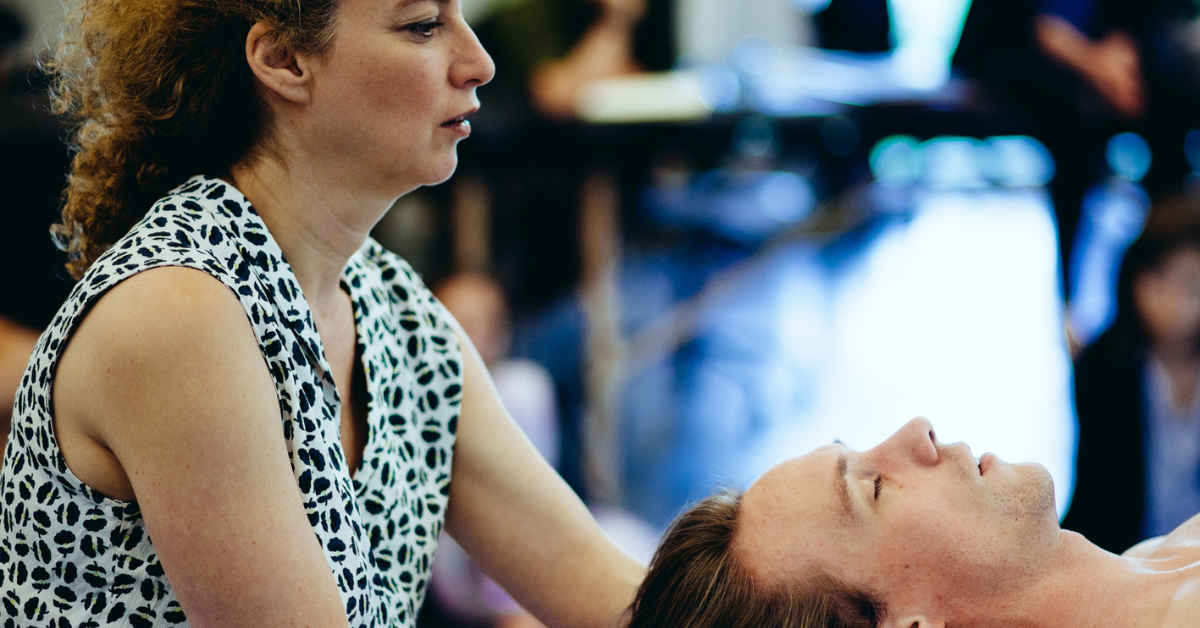
As my hands rested on his neck and head, I asked, “Do you remember how you felt in moments of connection before your wife passed away?”
Joe spoke about creativity. About how ideas used to flow easily, ideas for teaching, for family life, and for being together. “It felt as if there was a strong connection in my brain,” he said. “Everything could connect, move, and create something new.”
I was struck by how clear his description was. It was almost as if I could feel it myself while he was speaking. When I reflected this to him, Joe paused and then said, “That’s how it felt when I was a child.” This, he realized, was what he had lost. The loss of his wife was one thing, but the loss of his ability to feel was what kept him awake at night.
 Not a problem to solve
From a Pantarei Approach perspective, we don’t view life through a problem-solving mindset. A struggle is not something to fix. It is a doorway into who a person is.
Of course, I wanted Joe to reconnect with sensation and feeling, but first, I wanted him to sense that nothing about him was wrong. When we relate to ourselves as the problem, curiosity disappears. All that remains is the search for a solution.
Remembering space
I asked Joe about memories from his youth in which the world felt connected, as he had described.
Without hesitation, he spoke about the ocean. He grew up near the sea and remembered the sense of space, openness, and infinity. He spoke about inventing adventures with friends, forming a band, and being the one who brought everything together.
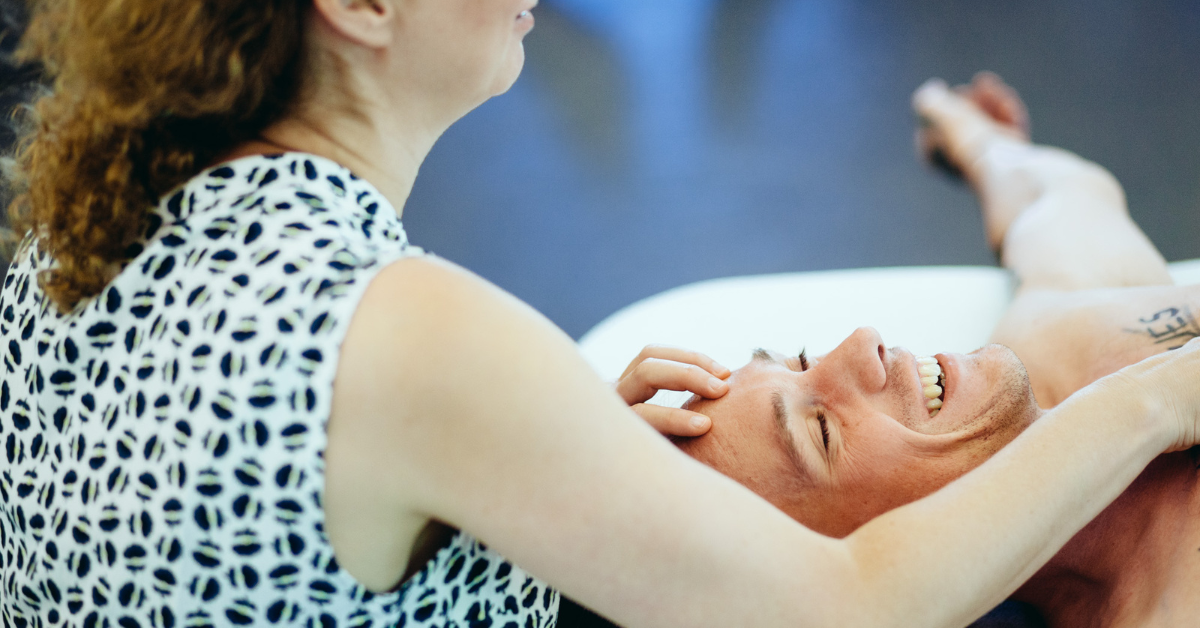
As my hands moved from his neck to his shoulders, I invited him to stay with the memory of the ocean, to feel the space, the colors, the vastness. I sensed a shift in the room even before his body showed it.
“My hands are starting to tingle,” Joe said.
I encouraged him to deepen his breath and stay with the sensation. His body responded quickly. His temperature changed. His arms grew heavier. A gentle shaking appeared in his legs and hands.
When the connection returns
“I don’t only connect to the ocean,” Joe said softly. “I also feel my wife here with me.”
Tears rolled down his cheeks. The water disturbed him, and yet he didn’t want to interrupt the moment.
A wider field
When Joe left the session, I reminded him that his sense of losing his body was the other side of how deeply he had loved.
“You try to connect to your children, your pupils, your wife,” I said. “What if you also allow yourself to connect to something larger, as you did as a child? The ocean. The sky. The stars.”
 What the body knew
As a Pantarei Approach practitioner, I tune into a person’s unique abilities. Joe had a strong capacity to sense space and connection. After his wife’s death, he focused entirely on functioning and caring for others. In doing so, he lost access to the very quality that nourished him. The more he tried to feel others, the further he drifted from feeling himself.
His sense that he had “lost his body” was accurate, but it was also a doorway. An invitation to remember his capacity for space, creativity, and connection.
The meeting
A few sessions later, Joe told me how he met his wife by the ocean. He had been sitting on vacation, watching the Atlantic, when the woman who would become his wife sat down beside him. They began talking about the water’s colors.